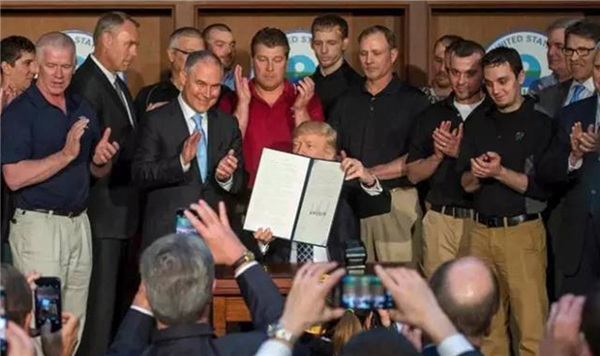
On March 28, Trump signed a new executive order to abolish the Clean Energy Initiative and the Climate Action Program launched during the Obama administration. 'Clean energy plan' plan 2030 US power plant carbon dioxide emissions in 2005 on the basis of the standard and then reduced by 30%, and the focus shifted to the development of renewable energy. 'Climate Action Program' is to strictly limit the carbon emissions of power plants, reduce the federal government's carbon emissions and strengthen investment in renewable energy research and development. The news spread to the country, triggered on the clean energy and China's energy supply side of the structural reform direction is correct discussion. The above discussion and interpretation on the one hand, misinterpreted the essence of US energy policy, on the other hand also shows that domestic people in the energy policy on the lack of strategic strength of the objective facts.
China's energy supply side of the structural reform is actually from the energy supply side to find a breakthrough, by optimizing the traditional energy and renewable energy or new energy ratio configuration, to achieve a new energy supply and demand model. According to the data published in the 13th Five-Year Plan for Renewable Energy Development, it is estimated that by 2020 and 2030, non-fossil fuels will account for 15% and 20% of primary energy consumption respectively. By 2020, commercialized renewable Energy utilization to reach 280 million tons of standard coal; all renewable energy power generation installed capacity of 680 million kilowatts, generating capacity of 1.9 trillion kwh, accounting for 27% of all generating capacity. Therefore, we can easily see that China's energy supply side of the structural reform trend is to improve the renewable energy or new energy in the energy structure of the proportion.
Sino-US 'renewable energy' at different stages of development
First, the United States 'renewable energy' in its energy structure as a whole accounted for a higher, and China 'renewable energy' is still in its infancy.
The US Sustainable Energy Business Council (BCSE) has published a report in the US Journal of Sustainable Energy that since 2008, US renewable energy capacity has increased threefold. As of the end of 2016, the United States by the wind energy, solar energy, biomass and geothermal and other renewable resources, renewable energy installed capacity has reached a record 141 gigawatts. At the same time, the proportion of US traditional energy is declining. By the end of 2016, the proportion of coal energy from the original 50% to 30%.
In 2015, China's commercialized renewable energy use of 436 million tons of standard coal, accounting for only 10.1% of total energy consumption. In the first quarter of 2016, China's thermal power installed capacity of up to 1 billion kilowatts. By the end of 2016, thermal power in the entire power supply accounted for as high as 60%, which is 30% of the proportion of US coal in sharp contrast. Therefore, China's energy structure and the United States there are significant differences in renewable energy reserves of a larger space for development.
Second, the United States 'renewable energy' is facing a strong resistance from the traditional energy industry, China's energy supply side of the structural reform has just started, has not yet formed a competitive mechanism.
The clean energy policy introduced during the Obama period is aimed at reducing greenhouse gas emissions by nearly one-third in the next 15 years, and its radical approach has caused some state discontent, especially against traditional energy operators. They think that Obama in the energy policy development on the ultra vires suspect. After the power reform in the early 1990s, the United States has traditionally been divided into power companies, power producers and electricity sales firms, which are traditionally regulated by state-controlled power generation, transmission and distribution, and other government enterprises. Unified supervision into separate supervision. The state has a big difference in energy policy, parallelism between regulatory and non-regulated dual-track, and it is difficult for the government to enforce coherence.
The ownership of traditional Chinese energy is different from that of the United States. Most of them belong to state-owned or state-owned holding, administrative law and market competition. China's energy supply side of the structural reform has just started, such as power reform has not yet formed a market competition mechanism.
Trump canceled the Obama administration's energy policy or out of frustration
Because of the different interest groups, the United States in the field of renewable energy development pace is severely constrained by traditional energy. In addition, the United States in the development of renewable energy on the stamina is weak, the Government is unwilling to bear the financial burden of renewable energy development. If Trump continues the Obama administration's energy policy, the US government will have to pay more for the financial subsidy. In order to stimulate the development of renewable energy, the United States has been subsidized, loan concessions, refunds and tax credits and other financial policies to be inspired. In July 2015, the United States in some states to implement a mandatory renewable energy power quota system, and in the market to give a lot of convenience of renewable energy, which makes the development of traditional energy has been suppressed. Therefore, the prosperity of the renewable energy market is inseparable from the government's financial support, which actually increases government spending.
Does China get more international strategic space?
Does Trump's revocation of the Obama administration's energy policy mean that the United States has abandoned the international dominance of renewable energy development? Will China win more international strategic space? This question still needs rational observation and analysis.
First of all, Trump's revocation of the Obama administration's energy policy has its inherent inevitability.
According to official data released by the US Department of Energy in January this year, the traditional energy industry, such as coal mining, created no more than 75,000 jobs in the United States, and the number of renewable energy industries (including wind, solar and biofuels) currently employed in the United States Has reached 650,000, is the former 8 times. This seemingly powerful data, but in fact ignored the traditional energy on the role of employment. US traditional energy automation is higher, under certain conditions of assessment, its employment driven by the role of renewable energy. In addition, the development of traditional energy after hundreds of years of evolution, has become an economic ecology. Although this ecology is at risk of worsening, it is still practically tested and is more effective in human beings, where there is a reasonable pattern of energy use. Even if the renewable energy in a short period of time to obtain rapid development, to a certain extent, the proportion of energy system imbalance. Traditional energy is based on its strong survival needs, the need to adjust the imbalance in the energy structure of the voice is inevitable.
Second, Trump withdrew the Obama policy of energy policy to make China's opportunities and challenges coexist.
Trump revoked the Obama policy of energy, China or will therefore get more strategic space in the international renewable energy market. China should seize this opportunity, in a more confident way, to participate in the global competition and output of energy. But China may also face the United States to resist the risk of renewable energy imports challenges. The Trump government energy policy is significantly different from the Obama administration's energy policy: Trump is focused on solving the problem of overburdened US energy development and developing all kinds of energy in a more conservative and secure way. Unlike the active energy trade policy of the Omaha government, the Trump government will build more conservative and upgraded energy trade barriers to bring risks and challenges to China's renewable energy output.
On the whole, the change of energy policy in the United States has great implications for China's energy supply side structural reform: it is imperative to build a reasonable energy supply ecosystem. For example, China's power reform is intended to create a market-oriented competition mechanism, but not completely market-oriented competition and may lead to new and old energy forces confrontation, may also increase the government's financial burden. On the development of renewable energy incentives and support policies, the Government should be on the horse, take a ride, send a way. If you want to make rapid development of renewable energy, the Government not only have the courage to 'let go', but also need to come up with wisdom to balance the interests of old and new energy interest groups to clarify their respective commitment to the energy supply task.